It cannot predict virality
A strong pattern can still underperform because distribution depends on audience fit, timing, execution, and changing platform behavior.
Workaround
Treat every post as a test and compare it with your own previous results.
TikTok workflow
Virlo tutorial TikTok guidance is easiest to apply when you turn discovery into a repeatable sequence: find a useful pattern, study its structure, and adapt the idea without copying it.
6 min read
Use this quick summary before working through the full process.
Move from observation to an actionable TikTok draft without treating another creator’s work as a script.
Choose a topic and collect several relevant TikTok examples. Look for recurring hooks, pacing, framing, proof points, and calls to action rather than chasing one isolated viral post.
Write down what happens in the opening three seconds, how the story changes from beat to beat, where visual proof appears, and what the viewer is asked to do next.
Keep the underlying audience problem, then replace the wording, footage, examples, and point of view. Draft one short version, publish it, and record what the audience response teaches you.
Prepare these inputs before you open a research session so the tutorial produces usable notes instead of an unfiltered bookmark pile.
Without every one of these the route does not run.
A defined TikTok audience or content niche.
Name the viewer and the problem the video should address.
One specific content goal for the session.
Examples include finding hooks, improving pacing, or planning a product demo.
A small set of relevant TikTok references.
Choose videos that share your topic or audience, not only videos with large view counts.
A place to capture timestamps, observations, and draft ideas.
A simple document or notes app is enough.
Skip any of these and the route still works — they only make it faster.
A rough filming or editing plan.
Optional at the research stage, but useful before you turn notes into a script.
These adjacent Virlo pages cover the platform context around the tutorial.
Adjust the same workflow for different TikTok jobs instead of using one research template for every audience.
Compare several openings in the same niche and identify the shared promise. Rephrase that promise around your own audience, then make the first visual prove what the caption or voiceover claims.
For a product or service video, map each claim to visible evidence. A close-up, before-and-after moment, screen recording, or user action is more useful than stacking adjectives into the voiceover.
Use the reference to understand the order of information, then change the setting, example, language, and conclusion. The goal is a familiar viewing rhythm with a genuinely different point of view.
The useful transformation is not a copy of the source video; it is a clearer version of the underlying content pattern.
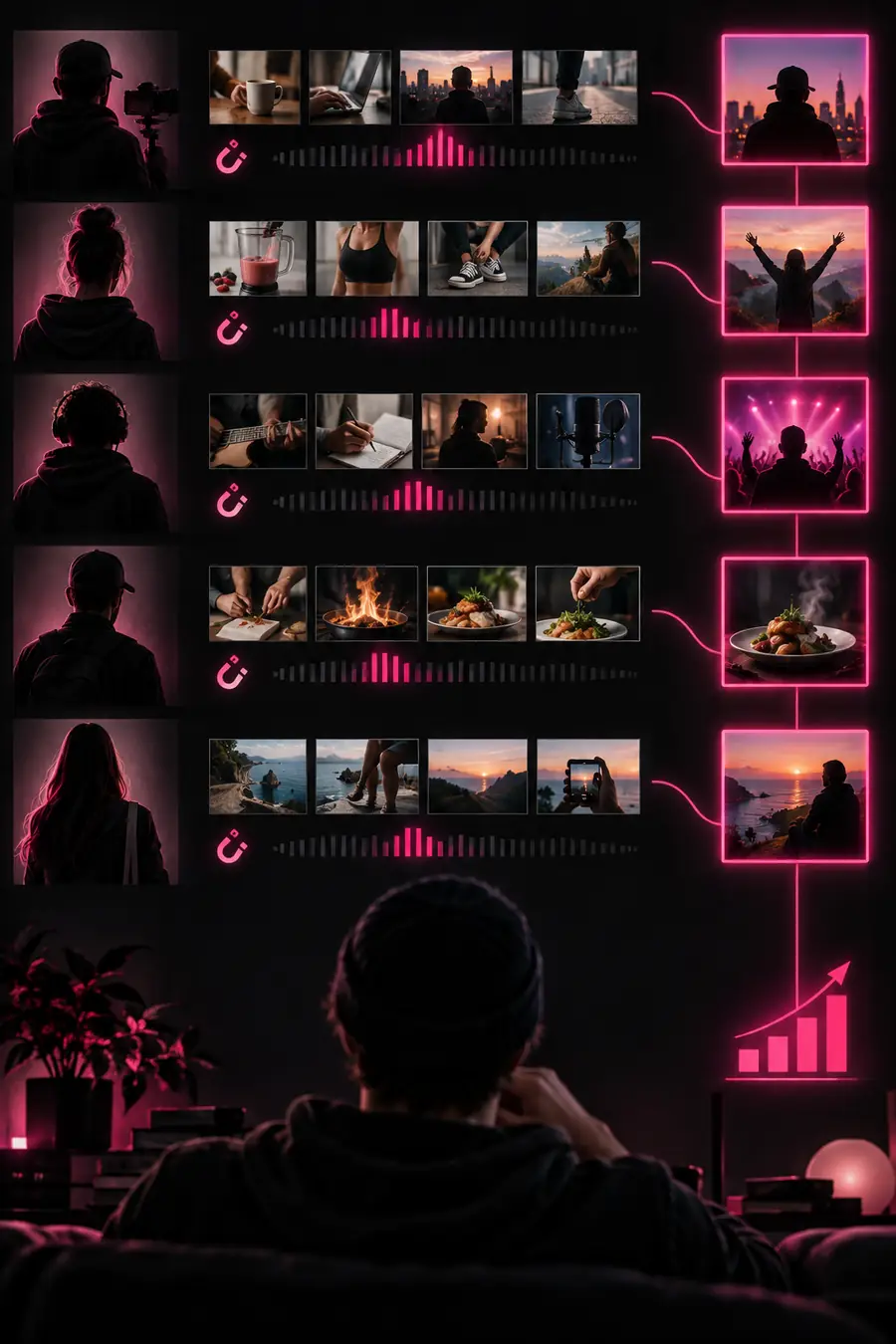
 Unsorted reference
Original working draft
Unsorted reference
Original working draft
Use the comparison as a planning model, not a promise of performance.
Unsorted referenceOriginal working draftA good tutorial should make failure modes visible before they cost you another filming session.
A strong pattern can still underperform because distribution depends on audience fit, timing, execution, and changing platform behavior.
Workaround
Treat every post as a test and compare it with your own previous results.
A tool can organize observations, but it cannot decide whether a hook is credible for your voice or appropriate for your audience.
Workaround
Review every suggestion against your niche, evidence, and brand standards.
Changing a few words or shots does not make another creator’s script, footage, or distinctive concept yours.
Workaround
Use references for structure, then write new language and create new examples.
Vague prompts produce broad ideas that are difficult to film, compare, or improve.
Workaround
State the audience, topic, desired action, format, and constraint before starting.
TikTok research has moved from isolated inspiration toward a more deliberate cycle of observation, adaptation, and testing.
Creators began studying recurring hooks, edits, captions, and proof moments across large collections of short videos.
Educational, product, commentary, and creator-led videos developed recognizable structures that could be analyzed without treating them as fixed scripts.
Teams increasingly compared drafts, opening variations, and audience signals rather than judging an idea from one reference alone.
The practical approach is to collect a focused set of references, extract transferable principles, create an original version, and learn from the result.
Start with one audience, one content goal, and one reference pattern. Use the workflow to turn those inputs into a draft you can film, publish, and improve with evidence.
Create TikTok workflowAnswers to the questions most closely tied to the Virlo tutorial TikTok search.
Begin with a defined audience and content goal, then collect relevant TikTok references. Break down their hooks, pacing, proof, and calls to action before creating an original draft for testing.
No. The core process is research and planning, so a notes document and a basic way to draft or edit a short video are enough. More advanced editing can be added after the idea is clear.
Use a focused set rather than an unlimited collection. The right number depends on your topic, but each reference should help you compare a specific element such as the opening, structure, proof, or ending.
No. A structured process can improve the quality of your testing, but it cannot guarantee views, reach, or distribution. Audience fit, execution, timing, and platform behavior still affect the result.
Extract the general pattern, not the exact script, footage, examples, or distinctive presentation. Rewrite the idea for your own audience and replace the source material with your own evidence and point of view.